Introduction: Beyond the Headlines
The recent protests by health workers across Nepal painted a familiar picture of a workforce demanding professional dignity, fair pay, and better conditions. While the headlines announced that an agreement had been reached, the story they told was only the beginning. A deep dive into the official Task Force Report reveals a settlement that is far more complex, revealing, and consequential than a simple pay dispute.
This agreement is not just a victory for labor rights; it’s a meticulously negotiated blueprint for reforming a critical sector of the nation, a blueprint that balances the urgent demands of labor against the economic realities of a strained private sector. It exposes deep-seated systemic challenges and illustrates the pragmatic compromises required to address them. Here are the five most surprising and impactful takeaways from the report that go far beyond the headlines.
1. It’s Not a Flat Pay Rise: The Surprising Two-Tier System for Private Hospitals
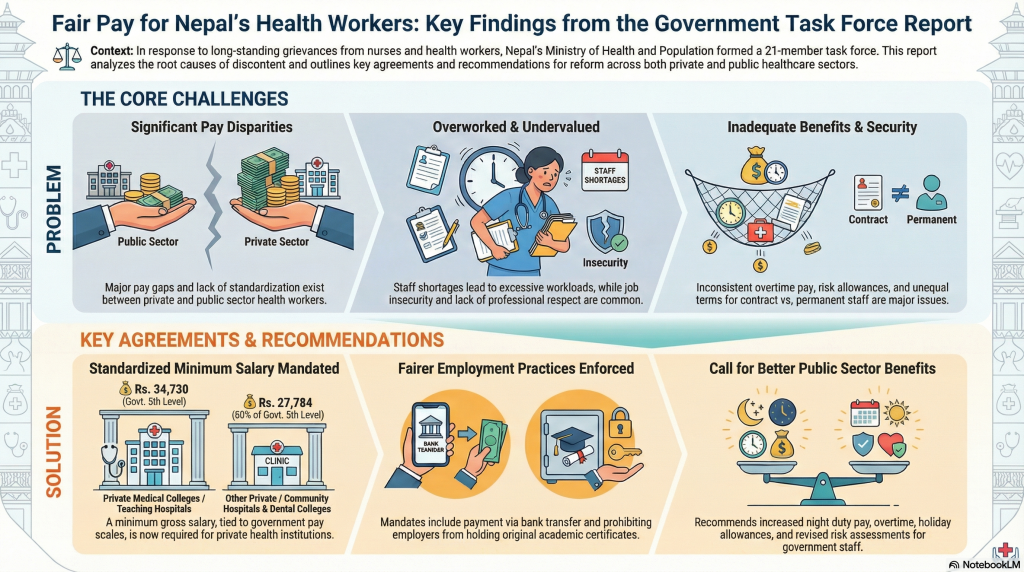
One of the most significant revelations is that the agreement for private sector pay isn’t a simple, one-size-fits-all mandate. Instead of a flat increase for all, the Task Force Report brokered a nuanced, two-tiered compromise that acknowledges the diverse financial realities within Nepal’s private healthcare landscape.

Based on the agreements in Section 8, Part A of the report, the new salary structure is as follows:
- Private Teaching Hospitals: These larger institutions are now required to pay a gross salary equivalent to the government’s fifth-level assistant (non-gazetted first class) starting salary scale at the time of the report, which is Rs. 34,730.
- Other Private/Community Hospitals and Dental Colleges: These institutions are required to pay 80% of that same government scale, amounting to Rs. 27,784.
This tiered approach is a classic policy compromise, avoiding a one-size-fits-all mandate that could have rendered smaller community hospitals insolvent. It is a pragmatic solution designed to raise the wage floor without causing widespread closures, thereby balancing the advancement of labor rights with the preservation of employment stability across the sector.
2. The Quid Pro Quo: What Private Hospitals Got in Return
In a move that reveals the true nature of the negotiations, the agreement wasn’t just about compelling employers to pay more; it was also about creating a more favorable business environment for them. To secure better pay and conditions for workers, the government task force also had to address the pressing needs of the private medical and dental colleges.
Section 8, Part B of the Task Force Report outlines several key “asks” from the private sector that the government agreed to facilitate. The key provisions included:
- Priority Sector Status: A push to have the health sector declared a “special priority sector” under the Industrial Enterprises Act, a designation that typically provides access to tax incentives, subsidized loans, and other fiscal benefits designed to spur investment.
- Easier Licensing: A provision to streamline bureaucracy by allowing for the renewal of hospital operating licenses for five years at a time, reducing administrative burdens.
- Government Facilitation of Negotiations: A commitment from the government to facilitate discussions with the Medical Education Commission to review student intake quotas, a critical revenue stream for teaching hospitals.
This wasn’t a simple transactional exchange but an alignment of incentives. The government recognized that to mandate higher labor costs, it also had to address the private sector’s long-standing complaints about regulatory friction and financial viability, effectively creating a more stable environment in which these new wage structures could survive.
Watch on Youtube
3. It’s a System-Wide Overhaul, Not Just a Nurse’s Issue
While nurses were often the public face of the protests, the Task Force Report makes it clear that the issues—and the solutions—span the entire healthcare system. The agreement is a blueprint for a systemic overhaul, addressing longstanding issues affecting a wide range of health professionals.
The report’s recommendations extend far beyond nursing salaries, including calls to:
- Fill Chronic Staff Vacancies: The agreement explicitly calls for the Ministry of Health and Population to coordinate with the Public Service Commission to fill all vacant government health worker positions, tackling a root cause of overwork and burnout that directly impacts patient care and staff retention.
- Create New Public Health Roles: In a forward-thinking measure justified by the National Nursing and Midwifery Strategy 2077/78-2087/88, the report recommends creating a new position for an “Industrial Nurse” in factories and workplaces with over 50 employees, embedding public health directly into the nation’s economic fabric.
- Address Diverse Professional Grievances: The agreement acknowledges the specific career progression and allowance issues of a wide range of professionals, with detailed demands from Dental Hygienists and Medical Laboratory Technicians included in the report’s appendices.
The scope of these recommendations proves that this was never just about one profession’s pay. It was an opportunity to address structural weaknesses across the board, from government hiring freezes to the creation of entirely new public health cadres.
Infographic
4. A Decade in the Making: The Agreement Stands on a History of Failed Promises
The grievances of Nepal’s health workers are not new, and neither are the government’s attempts to address them. The Task Force Report provides crucial historical context, revealing that this agreement is built upon the foundation of years of unheeded warnings and unimplemented directives.
The report’s “Past Efforts” section explicitly references previous high-level reports with similar recommendations, such as the one submitted by a committee led by Prof. Goma Devi Niraula Shrestha in 2016 (2073 BS) and another she convened in 2022 (2079 BS). Furthermore, the analysis section cites multiple government circulars and directives ordering fair pay that were simply never put into practice by institutions.
This history of unheeded warnings highlights a chronic failure of regulation. It makes the current agreement both a landmark achievement born of intense pressure and a crucial test of the state’s regulatory credibility and its ability to finally close an “implementation gap” that has plagued all past efforts.
5. Back to Basics: The Fight for Rights That Should Have Been a Given
Perhaps the most striking and sobering revelation from the Task Force Report is the extent to which the negotiations had to focus on codifying fundamental labor rights that should have been standard practice for years. The fact that these “basics” were central points of contention underscores the precariousness that many health workers have endured.
Among the key demands that had to be explicitly written into the agreement were:
- The requirement to pay all salaries through a formal banking system.
- The obligation to provide official employment contracts, prohibiting the use of daily-wage labor.
- The mandate to issue work experience certificates to employees upon request.
- A strict prohibition on the practice of employers holding employees’ original academic certificates as a form of coercive control.
Fetch The Original Report
The inclusion of these fundamental rights is the report’s most sobering admission. It signals that the problem wasn’t a lack of laws—these protections are already guaranteed under Nepal’s Labor Act (श्रर्म ऐन, २०७४)—but a systemic breakdown in enforcement, allowing for a work environment so exploitative that basic legal protections had to be renegotiated from scratch.
Conclusion: A Blueprint for Dignity, A Test of Will
The Task Force Report on health worker conditions is far more than a record of a pay dispute. It is a complex, negotiated settlement that touches upon industrial policy, regulatory enforcement, systemic staffing, and the fundamental human rights of workers. It provides a comprehensive blueprint for change, acknowledging the interconnected needs of employees and employers alike.
Ultimately, the report represents a fragile truce. Its success now hinges on the government’s willingness to enforce its own rules against powerful private interests—a willingness that has, until this point, been historically absent. The blueprint for dignity has been delivered; the test of political will has just begun.
Discover more from Public Health Concern Nepal
Subscribe to get the latest posts sent to your email.